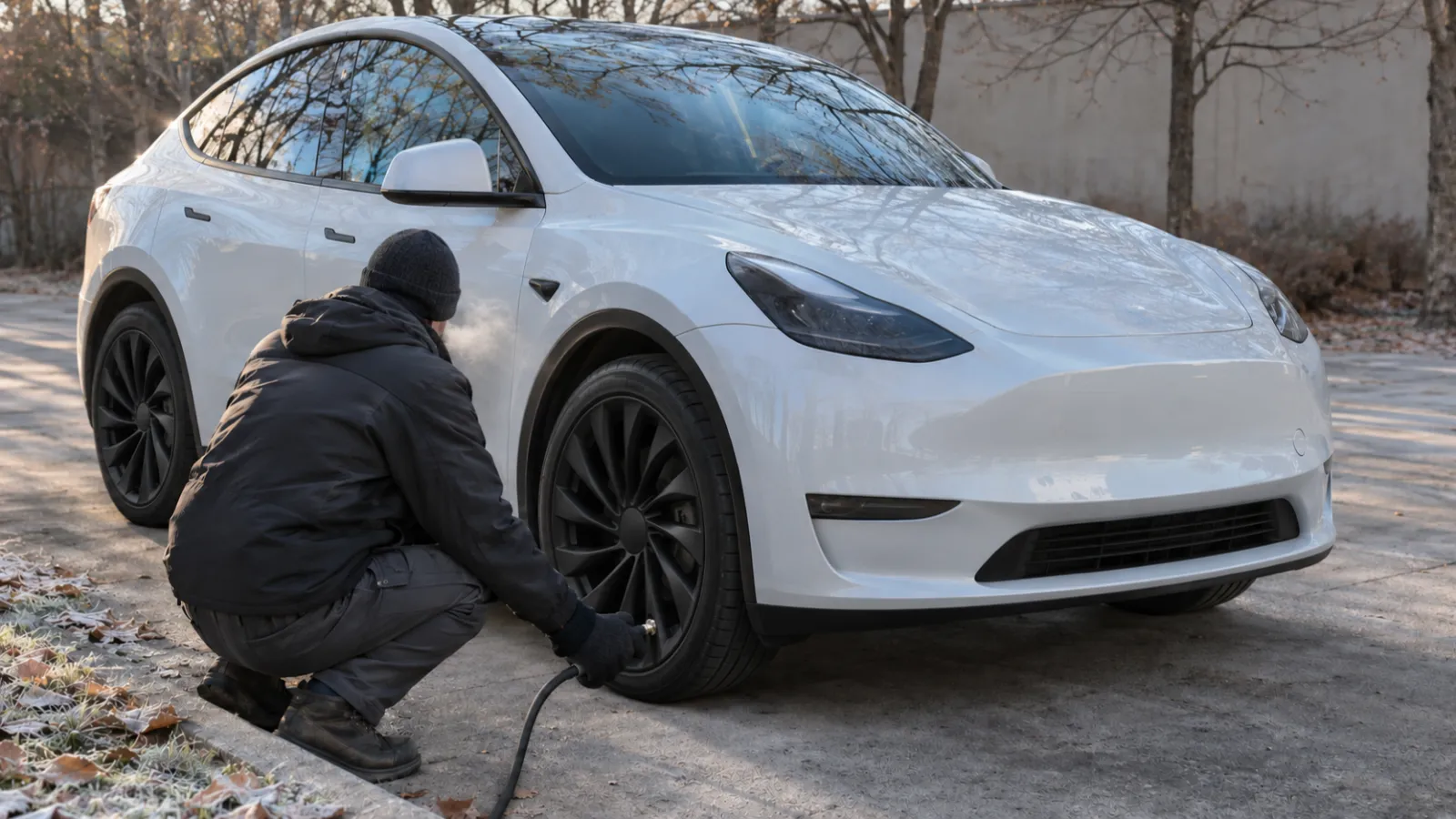
Tesla Tire Pressure: Recommended PSI, Cold Weather and TPMS Warnings
Your Tesla’s correct tire pressure is the cold pressure printed on the Tire and Loading Information label on the driver’s door pillar, and most cars show it on the touchscreen too. The number on the tire’s sidewall isn’t it. Tesla’s owner’s manuals print an everyday PSI in only two cases: 50 PSI for Cybertruck at normal load, and 42 PSI for a 2017–2023 Model 3 on Tesla accessory wheels. When the warning comes on with the first cold mornings, it’s usually genuine. Tires lose about 1 PSI for every 10°F (6°C) the temperature drops, so put some air in.
What pressure should a Tesla’s tires be?
You’ll find the Tire and Loading Information label on the center door pillar when the driver’s door is open. It gives the cold inflation pressures for the original front and rear tires. Tesla says that on UK cars, it’s visible with the passenger door open instead.
Model 3, Model Y, Cybertruck and the 2021 and newer Model S and Model X also show the recommended cold pressures on the touchscreen, next to the live readings.
On most cars, that’s all there is to it: the manuals list tire sizes and point you to the label. Here are the figures Tesla’s US manuals do print:
| Vehicle | When | Cold pressure |
|---|---|---|
| Cybertruck | Normal load, any of the three tire options | 50 PSI |
| Cybertruck, 20” All Terrain tires | Loaded up to GVWR, or towing | 65 PSI |
| Model 3 (2017–2023) | On Tesla accessory wheels or tires (18”, 19” and 20”) | 42 PSI (290 kPa) |
| Model 3 (2024 and newer) | Towing, on 18” or 19” tires | 42 PSI (290 kPa) |
| Model Y (2020–2024, 2025 and newer) | Towing | 42 PSI (290 kPa) |
| Model X (2021 and newer) | Towing | 45 PSI (310 kPa) on 20”, 49 PSI (338 kPa) on 22” |
| Model X (2015–2020) | Towing | 45 PSI on 19”, 46 PSI on 20”, 50 PSI on 22” |
If you’re towing, go by the towing figure rather than the label. Some cars have different towing pressures in Tesla’s European manuals, so check the towing section of your own manual. With the car loaded to capacity, make sure every tire’s at its recommended pressure before you set off.
The pressure molded into the sidewall is the tire’s maximum, not the number to aim for. And if you’ve put on aftermarket tires in a size that’s different from the label, Tesla leaves it to you to work out the correct pressure.
Checking the pressure
Do it once a month, with the tires cold. Tesla’s steps assume the car’s been parked for more than three hours. Driving about a mile, or parking in direct sun, warms the tires enough to change the reading.
Press an accurate gauge firmly onto the valve and add air (to let some out, press the metal stem in the center of the valve). Measure again, then put the cap back on to keep dirt out.
If you have to check them warm, expect a higher number, and never let air out to bring it down to the cold figure. Tesla warns that a hot tire that’s at or below its recommended cold pressure is dangerously underinflated.
Here’s where the car shows its own readings:
- Model 3 and Model Y: the cards area of the car status display, or Controls > Service, along with the time of the last measurement.
- Model S and Model X (2021 and newer): Controls > Service.
- Cybertruck: Controls > Service, or the Cards area.
- Model S (2012–2020) and Model X (2015–2020): the instrument panel, where the steering wheel buttons bring up Car Status. Tesla notes that only newer cars of this generation show pressures there.
On the touchscreen cars, values may not appear until you’ve driven a short way. Touch Controls > Display > Tire Pressure to switch between PSI and bar. Tesla also says you can view pressures in the Tesla app on Model 3, Model Y and the 2021 and newer Model S and Model X.
Some 2024 and newer Model 3 and 2025 and newer Model Y cars use indirect TPMS. There are no pressure sensors in the wheels; it only estimates pressure loss while you’re driving. To find out which you’ve got, open Controls > Service. If you see pressure values, your car has sensors (direct TPMS). If you don’t, only a gauge can tell you your pressures, and an amber icon next to a tire means check its pressure, while a red one means pull over.
Why the warning shows up in cold weather
By Tesla’s figures, tires lose about 1 PSI for every 10°F (6°C) drop in outside temperature. Set them on a mild afternoon and they can be 3 PSI down on a morning that’s 30°F colder. The low-pressure alert comes on once a tire’s at least 20% below its recommended cold pressure.
- Inflate before you drive. That’s what Tesla tells you to do when the light comes on in the cold.
- Fill to the label pressure. Tesla says the recommended cold pressure should be maintained at all times, whatever the weather.
- Don’t trust a warning that goes away. It may clear on its own as the tires warm up on the road. Add air anyway once they’ve cooled, Tesla says.
According to Tesla, underinflation is the most common cause of tire failures, and it costs you range and tread life too.
Reading the tire pressure light and alerts
You’ll see the tire pressure indicator on the touchscreen, or on the instrument panel in a Model S or Model X.
Steady light. A tire’s pressure is out of range, so check all four with a gauge. The light also flags an overinflated tire, according to Tesla’s manuals for Model 3, Model S and Model X (on a 2024 and newer Model 3, only with wheel sensors). On Model Y and Cybertruck, don’t count on it to catch an overfilled tire: the Model Y manuals say so in one passage but not in another, and Cybertruck’s only describes a low-pressure warning.
Flashes for about a minute when you power on, then stays lit. That means the monitoring system has a fault; it isn’t low pressure. Until it’s fixed, the car may not warn you about a soft tire, so schedule service.
“Air pressure below recommendation for tires” with “Check pressure and refill air as needed” (VCSEC_a221; the Model 3 manuals also list UI_a014, and the 2012–2020 Model S and 2015–2020 Model X use MCU_w010). At least one tire’s 20% or more below its recommended cold pressure. It doesn’t mean you’ve got a flat, so add air. If it keeps coming back for the same tire, get that tire inspected for a slow leak.
“Air pressure in tires very low” with “PULL OVER SAFELY - Check for flat tire” (VCSEC_a228; UI_a013 and MCU_w008 on the same cars). A tire’s extremely low or flat. Pull over carefully as soon as you can and take a look. You can request Tesla Roadside Assistance; when it isn’t an emergency, Tesla suggests a local tire shop or booking service in the app.
The light works off the label pressure, not the load you’re carrying (Tesla spells this out for Model Y, Model X and Cybertruck). A tire can also be low well before the 20% alert, so don’t skip the monthly check. If it’s a different warning you’re seeing, our guide to the Tesla 12V low-voltage battery warning covers it.
Once you’ve added air: when the warning clears
Filling the tires doesn’t switch the light off straight away. The sensors don’t report again until the car’s been driven above 15 mph (25 km/h), and Tesla’s alert text says that can take at least 10 minutes. Cars with indirect TPMS need recalibrating instead (see the next section).
If the warning’s still there after that, wait until the tires are cold and measure all four again. Frequent warnings can mean a sensor needs replacing, and Tesla’s advice is to book service.
Resetting TPMS after new wheels, tires or a rotation
Adding air doesn’t call for a reset. After wheel or tire work, what the car needs comes down to its hardware.
Cars with wheel sensors relearn them on their own after a wheel’s replaced. Drive above 15 mph (25 km/h):
- Model 3: within 10 minutes.
- Model Y, and Model S (2021 and newer): within two minutes.
- Model X, Cybertruck and newer 2012–2020 Model S cars: for more than 10 minutes. Tesla warns that Model X and Cybertruck may show false warnings before then.
No sensor relearn is needed when a new tire goes on the same wheel. Tesla says the same about a rotation on Model X, Cybertruck and the 2012–2020 Model S.
Older 2012–2020 Model S cars need a manual step after a wheel change. Inflate all four tires to the label pressure and be ready to drive for ten minutes. Then touch Controls > Service > Reset TPMS Sensors, follow the prompts and choose the correct wheel size. Tesla doesn’t give a cutoff year, so look for that menu item, and Tesla says not to use it to clear a pressure warning.
Cars with indirect TPMS (some 2024 and newer Model 3 and 2025 and newer Model Y) have to be recalibrated after any pressure adjustment, tire change, repair or rotation. First set all four tires to the recommended cold pressure. Then touch Controls > Service > Tire Pressure > Calibrate Tire Pressure and drive. Calibration takes at least 20 minutes above 15 mph (25 km/h), and until it’s done the car can’t detect low pressure.
After that, tell the car what’s changed:
- Different wheels: Controls > Service > Wheel & Tire > Wheels, on every model. This setting can affect the tire pressure warning levels, Tesla says. Replacing a stolen set? Our Tesla wheel theft article has tips on making the new ones harder to take.
- Rotated, replaced or seasonal tires: on Model 3, Model Y, Cybertruck and the 2021 and newer Model S and Model X, go to Controls > Service (Wheel & Tire > Tires) and update the tire configuration. Tesla says this can temporarily affect acceleration and regenerative braking, so only do it after actual tire work.
When a tire on a Model 3, Model Y, Model S or Model X is repaired or replaced by a shop other than Tesla, the sensor may not work until Tesla performs its setup procedure, Tesla warns.
Frequently Asked Questions
What PSI should Tesla tires be?
Use the cold pressures on the Tire and Loading Information label on the driver's door pillar; most Teslas also show the recommended cold pressure on the touchscreen next to the live readings. Tesla's owner's manuals print an everyday PSI in only two cases: 50 PSI for Cybertruck at normal load, and 42 PSI for a 2017–2023 Model 3 on Tesla accessory wheels or tires. For every other car the label is the answer, because the pressure depends on the tires it was built with.
Why does my Tesla's tire pressure warning come on when it's cold?
Because the pressure really has dropped. Tesla says tires lose about 1 PSI for every 10°F (6°C) fall in outside temperature, and the low-pressure alert appears once a tire is at least 20% below the recommended cold pressure. Add air to the label pressure while the tires are cold. The alert may clear as the tires warm up on a drive, but Tesla says to top them up anyway once they've cooled.
How do I reset the tire pressure light on a Tesla?
You don't reset it; you fix the pressure. Inflate the tires to the label pressure, then drive above 15 mph (25 km/h) and the light clears once the system has new readings. Two cases need a menu step. Some 2024 and newer Model 3 and 2025 and newer Model Y cars have indirect TPMS and must be recalibrated under Controls > Service > Tire Pressure > Calibrate Tire Pressure. Older 2012–2020 Model S cars use Controls > Service > Reset TPMS Sensors after a wheel change, never to clear a warning.
Can I see tire pressure in the Tesla app?
Tesla's manuals say you can on Model 3, Model Y and the 2021 and newer Model S and Model X, provided the car has wheel sensors. The manuals for the 2012–2020 Model S, 2015–2020 Model X and Cybertruck don't mention the app for this, so use the car's own display.
How long after adding air does the Tesla tire pressure warning go away?
Not immediately. The car has to be driven above 15 mph (25 km/h) before the sensors report again, and Tesla's alert text says that can take at least 10 minutes of driving. If the warning is still there after that, recheck the tires with a gauge when they're cold.
Should I inflate to the pressure on the tire sidewall?
No. The sidewall figure is the tire's maximum inflation pressure, not the target for your car. Tesla says to keep to the door-pillar label even where it differs from the number printed on the tire.